
Promotional image: Mr. Monopoly / Hasbro. Source: Hasbro
In Brief
Mr. Monopoly is an absurd Smash pitch, but Monopoly’s long gaming history gives the idea more weight than it should have.
- Core argument: Monopoly has a surprisingly deep video game legacy despite starting as a board game.
- The problem: Mr. Monopoly is a corporate mascot, not a traditional video game character.
- The hook: Dice, tokens, houses, hotels and bankruptcy could create a bizarre but genuinely distinct Smash moveset.
The world’s most infamous board game mascot might have a stronger gaming legacy than you think.
Few games have destroyed more friendships, shattered more family trust, or inspired more rage-induced table flips than Monopoly. Long before online lobbies and voice chat arguments, Monopoly was already weaponising capitalism in living rooms across the world. Smash Bros. thrives on gaming icons, but very few mascots can claim they have ended Christmas dinner conversations quite this efficiently.
First appearing in Monopoly artwork in the 1930s, Mr. Monopoly was long widely known as Rich Uncle Pennybags, with later Monopoly lore introducing the name Milburn Pennybags. The character’s design barely changed across generations: tuxedo, cane, top hat, enormous moustache and, contrary to what the internet still insists it remembers, absolutely no monocle.
Monopoly itself traces its roots back to Lizzie Magie’s The Landlord’s Game, a politically charged prototype intended to criticise wealth concentration and monopolistic greed before Parker Brothers transformed it into one of the most commercially successful board games ever created. Which is, frankly, one of the funniest accidental rebrands in entertainment history.
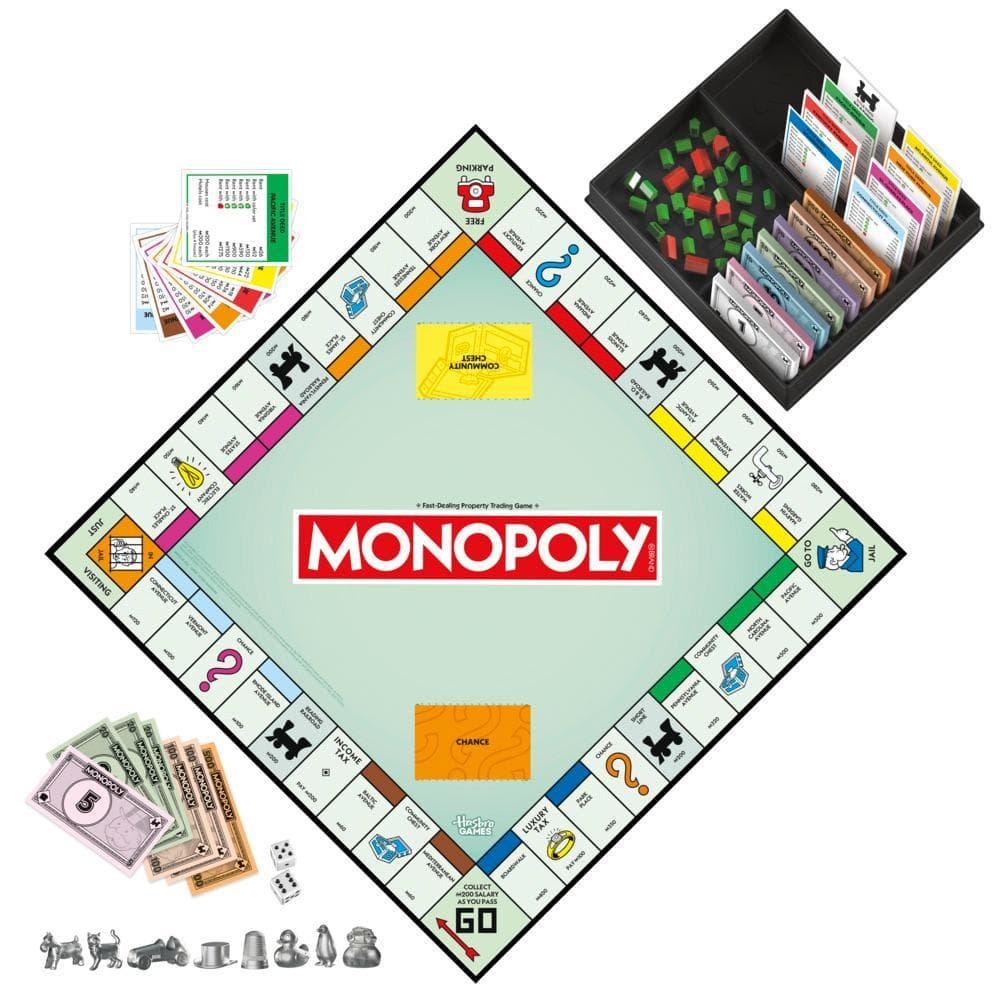
Contemporary Monopoly board game / Hasbro. Source: Hasbro
And despite the immediate instinct to dismiss Monopoly as “not a video game franchise”, its digital history is surprisingly enormous. Monopoly video games date back to 1985, and the series has appeared across NES, SNES, Game Boy, Nintendo 64, Game Boy Advance, GameCube, DS, Wii and Switch generations. More than 250 million Monopoly sets have reportedly been sold worldwide, while the franchise itself exists across over 100 countries and countless gaming adaptations.
Hasbro and Nintendo have even collaborated repeatedly through projects like Monopoly Gamer and Mario Kart Monopoly, transforming the traditional board game into something much closer to a party game built around Nintendo mechanics and characters. At a certain point, Monopoly stops feeling like a board game occasionally visiting gaming spaces and starts feeling like a gaming institution that simply originated elsewhere.
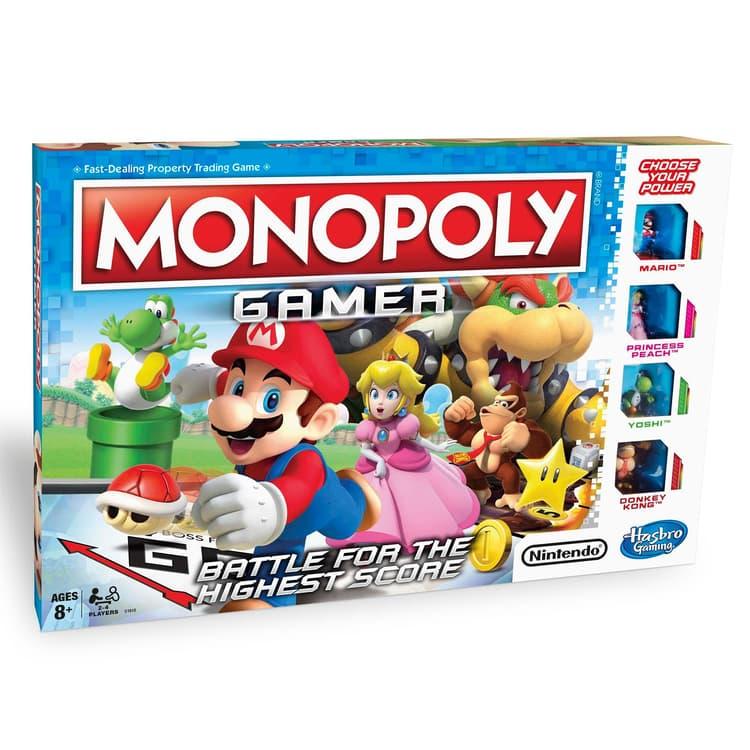
Box image: Monopoly Gamer / Hasbro. Source: Hasbro Instructions
Do Not Pass Go, Do Not Join Smash
That still does not erase the biggest issue: Mr. Monopoly did not originate as a video game character. He is the face of a massive corporate brand first and foremost, a mascot whose primary purpose is to sell board games rather than star in adventures. Smash has always stretched its rules, but its core identity still revolves around celebrating video game history specifically. Bringing in a top-hatted representative of aggressive venture capitalism would be a dramatic widening of that definition.
There is also the simple fact that Mr. Monopoly is not really a character in the same sense as Mario, Link or Sonic. He has no defining narrative, no rivalries, no mythology and no emotional arc beyond smiling confidently while charging somebody rent they cannot afford. If anything, his defining personality trait is functioning as an unnervingly cheerful landlord. That creates a difficult challenge for Smash because the game thrives on translating established identities into combat styles.
And yes, there is an argument that adding him would feel too corporate; less “celebration of gaming” and more “playable shareholder meeting”. Smash absolutely should not become a revolving door for mascots whose strongest qualification is global brand recognition. Let’s be honest, nobody wants a new character reveal to look like the world’s strangest advertising summit.
And yet, oddly enough, the deeper you look into Monopoly’s gaming legacy, the harder it becomes to dismiss entirely.
Landing On Smash Bros. Somehow Pays Out
For all the understandable resistance to the idea, Monopoly has maintained a more consistent release history than several franchises already represented in Super Smash Bros. EarthBound remains one of Nintendo’s most beloved cult series, but its release history is famously sparse. Kid Icarus largely vanished for decades outside of occasional revivals. Ice Climber effectively became dormant after the NES era.
Monopoly, meanwhile, has continued releasing games across console generations for over forty years without really disappearing from gaming culture at all.
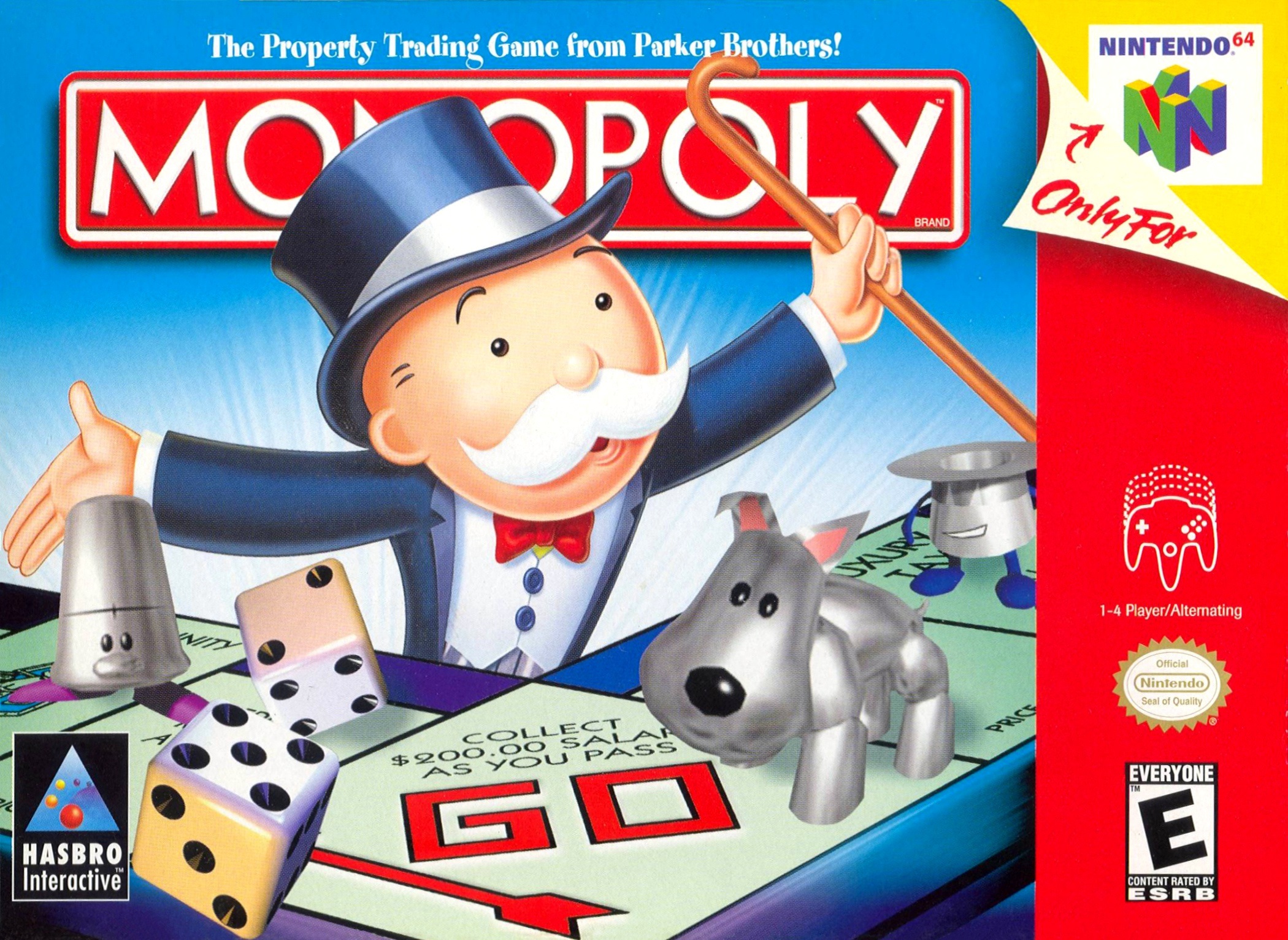
Box art: Monopoly for Nintendo 64. Source: LaunchBox Games Database
Just as importantly, Mr. Monopoly would represent something Smash has never tackled before: a board game-origin fighter. Smash already celebrates platformers, RPGs, retro hardware, peripherals, sandbox games, rhythm mechanics and fitness software. A tabletop gaming representative sounds absurd initially, but so did a living potted plant or an NES accessory before Nintendo turned them into functioning movesets.
That is ultimately the key to making Mr. Monopoly work. He would not fight as “Milburn Pennybags, secret master of the martial arts”. He would function as a conceptual fighter built entirely around Monopoly itself: dice rolls, property investment, tokens, Chance cards, hotels, going to jail and catastrophic financial collapse.
And honestly, once you start imagining exploding hotels and weaponised race car tokens flying across Final Destination, the idea becomes alarmingly easy to picture.
Because here’s the thing: Smash is often at its best when it stops asking “who deserves to be here?” and starts asking “what mechanics have we never seen before?” That philosophy gave us wildcards like R.O.B., Villager and Mr. Game and Watch. Mr. Monopoly would slot surprisingly naturally into that lineage of beautiful nonsense.
So if he did somehow land on the roster, the moveset would probably look something like this.
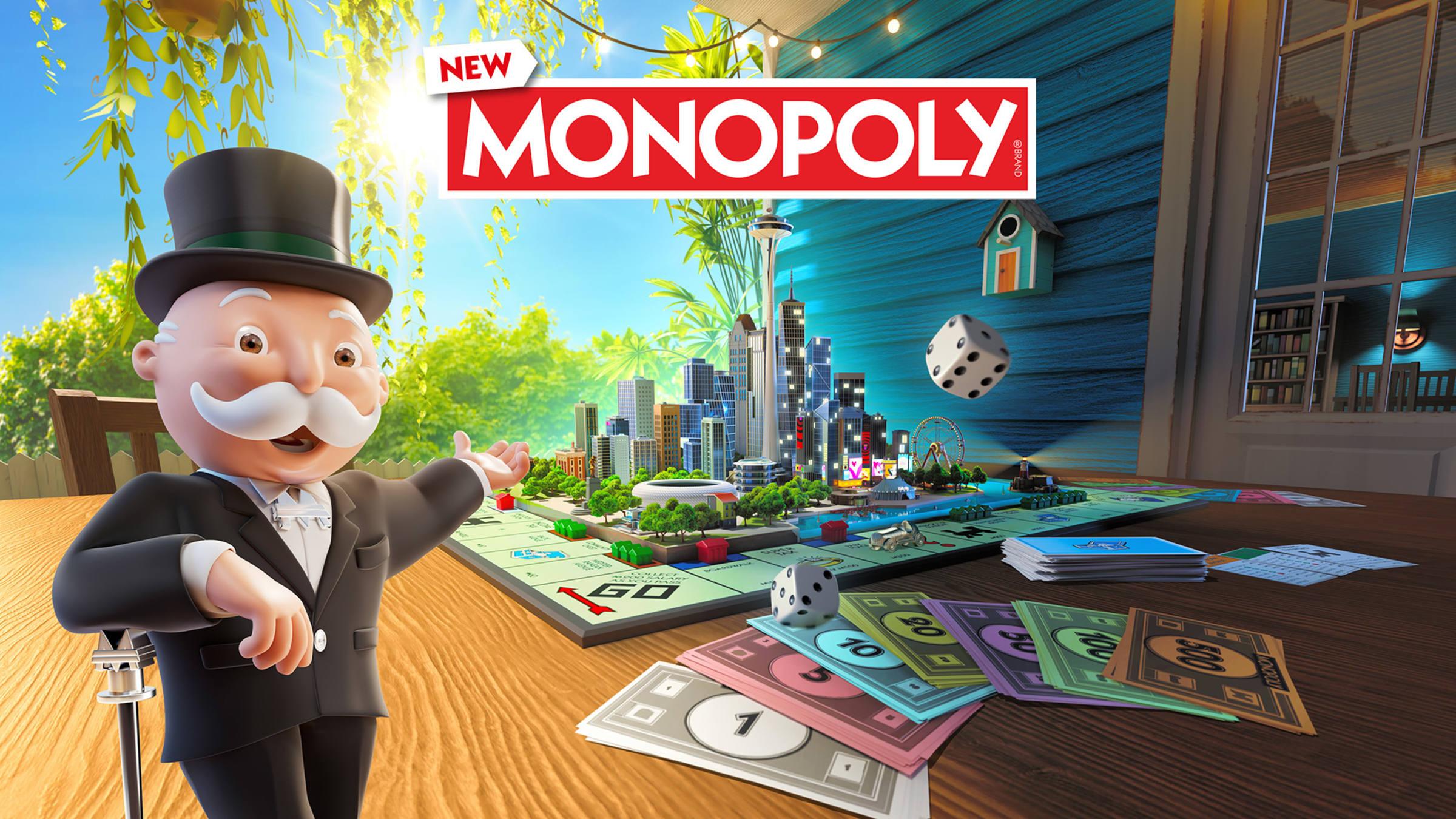
Recent video game image: New Monopoly for Nintendo Switch. Source: Nintendo
Mr. Monopoly Moveset Concept
Attributes
Weight: Medium-light
Movement: Brisk and energetic, with exaggerated cartoon swagger
Jump: Average
Archetype: A tricky setup fighter blending accessible fundamentals with Pac-Man-style item management
Basic Attacks
Jab
A quick one-two punch combo, followed by a playful cane tap.
Dash Attack
Mr. Monopoly stumbles forward while trying to stop himself, sliding shoes-first into opponents in full cartoon panic.
Tilts
Forward Tilt
He thrusts his cane forward with gentlemanly precision.
Up Tilt
He flips his top hat upward, catching opponents above him.
Down Tilt
A low sweeping cane trip across the ground.
Smash Attacks
Forward Smash
Mr. Monopoly winds up and swings his cane like a baseball bat, sending opponents flying with a loud crack.
Up Smash
He raises a small green house overhead while charging. More houses stack upward as the charge increases, eventually becoming a full red hotel at maximum power before bursting upward.
Down Smash
A Chance Chest slams down on one side while a Community Chest crashes down on the other.
Aerials
Neutral Air
He spins awkwardly with his cane extended outward.
Forward Air
He swings a folded deed booklet downward like a dismissive backhand slap.
Back Air
A frantic backward double kick that looks far less coordinated than it actually is.
Up Air
He jabs his cane overhead.
Down Air
He drops a heavy money bag beneath him.
Grabs & Throws
Grab
A straightforward two-handed grab with surprising force for his age.
Pummel
He bonks opponents with the handle of his cane.
Forward Throw
A sharp kick forward, paired with a very clear “off my property” energy.
Back Throw
He pivots and tosses opponents backward over his shoulder.
Up Throw
He launches them upward with a burst of flying paper money (Monopoly money, naturally).
Down Throw
Opponents are briefly pinned beneath scattered cash and property deeds.
Special Moves
Neutral Special — Token Cycle
Mr. Monopoly cycles through classic Monopoly tokens in a fixed order, with stronger tools appearing later in the rotation. Much like Pac-Man’s Bonus Fruit system, players can intentionally prepare specific options depending on the situation.
Thimble: A tiny rolling projectile that trips opponents
Scottie Dog: Runs forward and bites once
Boot: A short-range heavy projectile
Wheelbarrow: Pushes opponents forward while rolling
Top Hat: Tossed upward in an anti-air arc
Cat: Leaps diagonally and inflicts bleed damage
Race Car: Extremely fast projectile with strong knockback
Battleship: Fires a devastating cannon blast with genuine KO power
This is where the concept really clicks. Monopoly’s tokens are already iconic enough to function like Smash items, and structuring them into escalating utility gives the move surprising strategic depth instead of pure gimmick chaos.
Side Special — Roll the Dice
Mr. Monopoly throws two dice and charges forward based on the displayed roll. The move is fully charge-controlled rather than random: tapping the move produces a low roll and short safe dash, while fully charging raises the dice values all the way to double sixes for maximum speed, distance and knockback.
The move captures Monopoly’s central mechanic perfectly while still feeling skill-based within Smash itself; risky, explosive and just slightly reckless.
Up Special — Go To Jail
A metal jail cell drops around Mr. Monopoly before a helicopter lifts the cage upward at an angle. The cell provides brief protection during startup, offering decent vertical recovery. Once the helicopter departs, however, he enters a helpless fall unless he reaches the ledge in time.
Down Special — Long Term Investment
Mr. Monopoly places a small green house on the ground as a trap. Reusing the move upgrades it into a red hotel.
House: Minor damage with upward knockback
Hotel: Powerful “rent payment” explosion with major launch power
Only one property trap can exist at a time.
Building houses and hotels is the heart of Monopoly’s progression system, and turning that escalating pressure into stage control feels surprisingly natural within Smash’s ruleset.
Final Smash
Bankruptcy
Mr. Monopoly checks his pockets and realises he has run out of money. His cheerful expression collapses into complete fury as he violently flips the Monopoly board into the air.
The arena erupts into flying cash, dice, deeds, houses, hotels and spinning tokens while trapped opponents are dragged through the chaos before one final explosive table flip launches them away.
It perfectly weaponises Monopoly’s real-world reputation: not as a relaxing family game, but as a slow-motion economic collapse disguised as entertainment.
Adding Mr. Monopoly Might Just Pay Off
That is the strangest part of the entire concept. The more seriously you examine Mr. Monopoly as a Smash fighter, the less he feels like a throwaway joke pick and the more he starts resembling the exact kind of bizarre design challenge Smash thrives on.
Nintendo has spent years proving that unconventional characters can become standout roster additions when their mechanics are clever enough. Duck Hunt Duo turned an old accessory into a zoning specialist. R.O.B. became a fully realised fighter despite originating as a toy. Piranha Plant somehow evolved from “generic Mario enemy” into one of Ultimate’s most memorable wildcard inclusions.
Mr. Monopoly fits surprisingly neatly into that same philosophy. He is ridiculous, commercially absurd and probably the closest Smash could ever come to adding a literal landlord to the roster. He would absolutely trigger debates about corporate mascots invading Smash, and there is something deeply funny about a game built on Nintendo’s colourful heroes suddenly making room for a wealthy property tycoon whose entire business model revolves around economic domination.
And yet, against all common sense, the concept has genuine mechanical identity, decades of gaming history, global recognisability and enough visual iconography to instantly communicate itself onscreen.
No, Mr. Monopoly joining Smash is not likely. It is not even remotely realistic. But somewhere between the exploding hotels, flying deeds, collapsing friendships and weaponised capitalism, the idea stops sounding impossible.
Which, for a Smash roster pitch this absurd, might actually be the strongest argument in its favour.
 Canonyx
Leave a comment