

Peashooter appears in an HD character render from Plants vs. Zombies 2. Image: EA / PopCap Games. © Electronic Arts. All rights reserved. Source: Plants vs. Zombies Wiki

In Brief
Peashooter is an unlikely EA standard-bearer, but Plants vs. Zombies gives him a clearer Smash identity than the publisher hierarchy suggests.
- Core Argument: Peashooter combines the lane-control identity of classic Plants vs. Zombies with the mobility and combat language of Garden Warfare.
- The Problem: EA has far larger franchises to represent, while Smash already gave its most famous botanical wildcard slot to Piranha Plant.
- The Hook: Pea Cannon pressure, Chili Bean Bomb traps, Pea Suped mobility and rooted Pea Gatling fire could create a genuinely distinct positional zoner.
EA has footballers, soldiers and galaxy-saving heroes. Somehow, its best route into Smash might be a pea-firing garden defender.
If Electronic Arts finally earned a playable fighter in Super Smash Bros., Peashooter would look like a punchline.
That is not necessarily a weakness. This is the series that once revealed Piranha Plant with a straight face, after all. Smash has never been particularly interested in respecting the corporate hierarchy of video game characters. Sometimes the mascot gets the invitation. Sometimes an anonymous enemy, plastic peripheral or fitness instructor wanders through the door instead.
Electronic Arts itself has been part of the industry since 1982, growing into one of gaming’s largest publishers across sport, racing, shooters, simulation and role-playing games. PopCap came from a very different corner of the business. Founded in a Seattle attic in 2000 by three veterans of the dot-com era, the studio built its reputation on accessible games such as Bejeweled, Zuma and Peggle before Plants vs. Zombies arrived in 2009.
Plants vs. Zombies was another brilliantly simple idea. Zombies advance across a suburban lawn, plants hold the line, and increasingly ridiculous gardening solutions prevent somebody’s brains from becoming dinner. Peashooter sits at the centre of that formula, firing directly along his lane while Sunflowers generate resources, Wall-nuts absorb punishment and Crazy Dave remains exactly as helpful as Crazy Dave usually is.

Plants vs. Zombies: Replanted returns Peashooter and the familiar lawn-defence formula to the front line. Image: EA / PopCap Games. © Electronic Arts. All rights reserved. Source: EA
EA acquired PopCap in 2011, framing the deal as part of its wider digital expansion. Plants vs. Zombies subsequently became much more than a tower-defence series. The original Garden Warfare passed one million players only months after its 2014 launch and had reached more than eight million players by late 2015, giving PopCap ample reason to push its strange experiment further.
Garden Warfare 2 followed in February 2016 with more character classes, larger battles and the Backyard Battleground hub. More importantly for our purposes, it cemented Peashooter as a proper third-person shooter combatant rather than a plant permanently attached to one square of grass.
That game has shown remarkable staying power of its own. EA was still updating its PC version with new anti-cheat technology in March 2024, eight years after release. Battle for Neighborville continued the shooter branch, while Plants vs. Zombies: Replanted returned to the original formula on 23 October 2025 across platforms including Nintendo Switch and Switch 2. Plants vs. Zombies 3: Evolved then entered Early Access in April 2026, beginning in Ireland and the Philippines before expanding through a limited number of other regions, once again putting lane-based strategy at the heart of an active PvZ project.
Bizarrely, EA already has some minor representation in Super Smash Bros., although it comes with one of those technicalities seemingly designed to ruin trivia nights. Dr. Wright from the SNES version of SimCity has appeared in Smash as both trophy and Assist Trophy material. SimCity is now an EA-owned universe, but Dr. Wright was created for Nintendo’s adaptation and is generally treated as a Nintendo-created character inside that very strange loophole.
Peashooter would therefore not be Smash’s first brush with an EA-owned universe. As of the current roster, however, he would be its first proper playable fighter drawn from EA-owned IP.
That leaves him in a wonderfully awkward position. Peashooter is not EA’s biggest character, nor is Plants vs. Zombies its most prestigious franchise. He is not even a traditional protagonist. Yet once the question shifts away from corporate hierarchy and towards who could actually work in Smash, the little green plant starts causing problems.
Why Peashooter Should Stay on the Lawn
The first obstacle is almost embarrassingly obvious.
Smash already has a plant.
Piranha Plant was not merely an unusual Super Smash Bros. Ultimate newcomer. Its reveal was arguably the biggest curveball pick Smash has ever produced. Mario is one of the grandest franchises in the medium, overflowing with heroes, villains and decades of familiar faces, yet Nintendo somehow reached into the Mushroom Kingdom and promoted one of its generic carnivorous plants instead.
That precedent helps Peashooter because it proves a species does not need an elaborate biography to earn a roster slot. It also means the novelty has already been spent.
Peashooter and Piranha Plant are hardly identical, but the visual comparison writes itself. Both are green botanical oddities built around oversized heads, thin stems and extremely questionable mouth situations. To somebody unfamiliar with Plants vs. Zombies, another plant-shaped fighter risks looking less like a bold roster expansion and more like Nintendo accidentally watered the same idea twice.
There is also the question of whether Peashooter is even the right representative. Crazy Dave has considerably more personality. Dr. Zomboss brings villainous spectacle. Sunflower is enormously recognisable. Peashooter, by comparison, is deliberately basic.
That simplicity is part of his appeal. In the original game, he communicates the offensive premise almost instantly: place him in a lane and he fires at whatever approaches. He became recognisable because the idea is so clean, not because he has decades of dialogue and heroic monologues waiting to be adapted.
Then there is Electronic Arts itself.
Its sporting footprint alone is enormous. The former FIFA series, now succeeded by EA Sports FC, and Madden NFL both sit among EA’s biggest properties and among the most commercially recognisable sports series in gaming. EA Sports has also spent decades covering sports as varied as ice hockey, golf and mixed martial arts. Need for Speed gives the company another enormous long-running franchise before we have even reached the rest of the catalogue.
Outside sport, the list barely gets easier to summarise. The Sims represents life simulation on a scale few series can match. Battlefield and Apex Legends cover two very different approaches to multiplayer shooting, while Mass Effect carries an entirely different kind of science-fiction prestige. PopCap brings Bejeweled and Peggle into the family too, while EA Originals has published games such as Unravel, It Takes Two and Split Fiction.
Against that background, choosing Peashooter sounds almost wilfully strange. Imagine announcing that Electronic Arts had finally joined one of gaming’s largest crossover rosters, only to reveal that Commander Shepard, a Sim and some of the biggest sportspeople on the planet had apparently lost the company vote to a plant that says nothing and fires peas from its face.
Technically, peas are legumes, but that probably makes the explanation worse.
There is also the sheer weight of the EA name. Peashooter would not arrive as an isolated PopCap character; fairly or otherwise, he would be treated as the playable representative of a publisher associated with everything from annual sports releases and sprawling simulation games to military shooters and galaxy-spanning role-playing adventures.
That tension is not entirely unlike Mr. Monopoly’s Smash case, where the character himself is almost less important than the enormous identity he is being asked to carry into the roster. Peashooter at least comes from a video game first, but representing the wider EA catalogue through one lawn defender would still be a remarkably strange promotion.
That is a lot to place on the shoulders of a character who does not technically have shoulders.
Please Do Not Make Him Piranha Plant With Ammunition
The character-choice problem is only half of it. Peashooter’s defining action is shooting horizontally, and Smash already has enough projectile users to make that sentence slightly threatening.
A bad Peashooter moveset is painfully easy to imagine. Shoot peas, retreat, shoot more peas, then occasionally remember that Plants vs. Zombies contains other mechanics. Few things drain the charm from a fighter faster than discovering that their entire strategic philosophy involves standing on the opposite side of Battlefield and making everybody else deal with it.
That interpretation would also make the Piranha Plant comparison worse.
Piranha Plant is an eccentric close-range creature built around biting, extending and exaggerated Mario enemy behaviour. Peashooter should occupy almost the opposite territory. He is not the plant that wants you standing beside him. He is the plant trying to make the space between you increasingly inconvenient.
There is a real distinction there, but only if the moveset commits to it.
Peashooter needs to control space without becoming tedious, remain recognisable without becoming simplistic, and move around a fighting stage without forgetting that his original claim to fame involved being firmly planted in one patch of grass. Merely giving a projectile character good frame data would not solve any of those problems. The design needs a rhythm: establish a lane, complicate the approach, reposition, then decide whether committing to the ground is worth the danger.
That adaptation problem sits surprisingly close to the logic behind the Stardew Valley Farmer Deviation. The goal is not to pretend the source character secretly came from a traditional fighting game. It is to identify what their original game asks the player to think about, then translate that behaviour into Smash without losing the identity that made the character interesting in the first place.
Fortunately, Plants vs. Zombies has already stress-tested almost every adaptation problem Smash would face.
Garden Warfare Already Did the Difficult Part
Garden Warfare asked what happens when a tower-defence unit is uprooted and allowed to run around a battlefield.
The answer was not simply a Peashooter with legs. PopCap turned him into an agile combatant while keeping the basic fantasy intact.
His Pea Cannon remained the foundation, but the surrounding abilities gave it shape. Chili Bean Bomb introduced a delayed explosive threat. Pea Gatling rooted him in place for sustained fire. Hyper, and later Pea Suped, gave him exaggerated speed, jumping and aerial mobility. Battle for Neighborville describes Peashooter as a versatile combatant built around Pea Cannon, Chili Bean Bomb, Pea Gatling and Pea Suped.

Peashooter’s shooter-era identity comes into focus in artwork based on Plants vs. Zombies: Battle for Neighborville. Image: EA / PopCap Games. © Electronic Arts. All rights reserved. Source: Plants vs. Zombies Wiki

That transition unlocks the Smash concept.
The original Plants vs. Zombies supplies Peashooter’s strategic identity. He controls a lane, applies pressure from a distance and makes approaching him inconvenient. The shooter games add movement, commitment and risk. A character associated with standing still suddenly has reasons to leap across the battlefield, create delayed threats or deliberately plant himself somewhere dangerous.
It separates him from Piranha Plant more effectively than the character models ever could. Piranha Plant translates the physical absurdity of a Mario enemy into a brawler. Peashooter can translate the positional thinking of tower defence into a mobile zoning character. One celebrates what a bizarre creature can physically do. The other asks how much of the stage it can persuade you not to occupy.
Plants vs. Zombies also fills an interesting gap because Peashooter could represent both halves of the franchise rather than only its tower-defence origins. The original games give him lanes, specialised roles and the constant knowledge that one neglected route can turn a perfectly organised garden into an all-you-can-eat buffet. Garden Warfare and its successors give him an equally legitimate third-person shooter identity, complete with mobility, explosives and sustained ranged pressure.
Peashooter is perhaps the cleanest symbol for that combination, and he does not need to represent every plant personally. Turning him into Pokémon Trainer with a compost bin would miss the point. Sunflower, Chomper and Cactus could populate the background of a Plants vs. Zombies stage, while Crazy Dave and Dr. Zomboss provide the wider personality and spectacle. A few familiar faces might even find their way into his Final Smash, assuming the lawn war ever gets sufficiently out of hand.
His Nintendo history helps too. Plants vs. Zombies reached Nintendo DSiWare in Europe on 6 May 2011. Battle for Neighborville Complete Edition later arrived on Switch on 19 March 2021, followed by Replanted on Switch and Switch 2 in October 2025. Peashooter would still be an unmistakably third-party guest, but he would arrive with a Nintendo-platform history stretching back roughly fifteen years by the time this hypothetical pitch is being made, rather than being air-dropped into Smash because a licensing department had an unusually productive Tuesday.
More surprisingly, Peashooter may suit Smash better than several grander EA candidates.
The Sims represents more of the publisher’s history, but immediately creates the problem of adapting a completely customisable avatar into one definitive fighter. EA Sports presents an even stranger dilemma. Few parts of Electronic Arts are more important to the company, yet properly representing that history could mean putting an actual licensed athlete into Super Smash Bros. Suddenly Mario is not fighting a fictional footballer. He is drop-kicking a recognisable human being whose day job happens on television every weekend.
That is a different flavour of Deviation entirely, and the licensing conversation alone could probably qualify for extra time.
Mass Effect offers a far stronger conventional protagonist, but Peashooter has the cleaner Nintendo relationship and considerably fewer firearms that need explaining to Kirby.
Most importantly, his absurdity feels like Smash absurdity. This is a roster containing a fitness instructor, an NES accessory and Piranha Plant itself. Peashooter does not threaten that ecosystem. He looks like he has been growing in it for years.
That is a very different problem from the one facing SpongeBob SquarePants, whose Deviation has to argue with Smash’s video-game-only boundary before the moveset discussion can even begin. Peashooter is strange, but he is strange in exactly the right medium.
The moveset therefore has one job: make Peashooter feel like a lane-control specialist who can uproot, reposition and commit, rather than a projectile dispenser in a flowerpot. The original games supply the tactical grammar. Garden Warfare supplies the movement and risk.
Put those together, and the fighter should look something like this.
Moveset Dossier
Peashooter Moveset Concept
Attributes
Weight
Light-middleweight. Peashooter is small and narrow, but sturdy enough to avoid being among the roster’s lightest fighters.
Movement
Average natural ground speed with good aerial steering and a small profile. His more explosive mobility comes from Pea Suped rather than his standard movement.
Jump
Modest natural jumps, supported by Pea Suped for a powerful boosted leap and brief hover.
Archetype
A mobile mid-range zoner who controls horizontal space through pea fire, delayed explosives and temporary rooted turret pressure.
Basic Attacks
Jab
Peashooter swats with one leaf, then the other, before thrusting his head forward in a quick bump that pushes opponents away.
Dash Attack
Peashooter bounds forward almost horizontally and rams mouth-first into the opponent, his flexible stem springing upright afterwards.
Tilts
Forward Tilt
Peashooter swings one broad leaf-arm horizontally in front of himself, creating breathing room with a quick mid-range swat.
Up Tilt
Peashooter bends his stem and whips the leaves on top of his head through an overhead arc, covering directly above and slightly behind him.
Down Tilt
Peashooter crouches almost flat and sweeps one of his broad base leaves across the ground, sending opponents upward for aerial follow-ups.
Smash Attacks
Forward Smash
Peashooter digs his roots in and fires an explosive pea at point-blank range, producing a powerful blast immediately outside his mouth.
Up Smash
Peashooter bends backwards, aims directly upward and fires an explosive pea that catches nearby opponents before bursting overhead.
Down Smash
Peashooter coils his stem, then violently unfurls his broad base leaves across the ground on both sides.
Aerials
Neutral Air
Peashooter corkscrews in midair with his leaves spread around his body, creating a quick defensive hitbox on all sides.
Forward Air
Peashooter thrusts his head forward and spits a pea at extremely close range, combining the muzzle burst and projectile into one compact blast.
Back Air
Peashooter twists his stem and lashes both rear leaves behind himself, with the leaf tips providing the strongest hit.
Up Air
Peashooter flicks his head and upper leaves sharply upward in a quick aerial strike.
Down Air
Peashooter straightens his stem and drops base-first with his lower leaves pointed beneath him. A clean hit can meteor smash.
Grabs & Throws
Grab
Peashooter reaches forward with both leaf-arms and clamps them around the opponent from short range.
Pummel
Peashooter bumps the trapped opponent with the rim of his mouth.
Forward Throw
Peashooter holds the opponent in front of his mouth and fires a point-blank pea, blasting them forward.
Back Throw
Peashooter twists his flexible stem and flings the opponent behind himself with both leaves.
Up Throw
Peashooter tosses the opponent overhead, aims upward and shoots them with a pea to launch them higher.
Down Throw
Peashooter briefly roots himself and forces the opponent into the ground with his head, bouncing them upward for a follow-up.
Special Moves
Neutral Special — Pea Cannon
Peashooter fires a pea directly ahead. Tapping the button produces individual shots, while holding it allows him to continue firing at a steady rhythm. The peas travel quickly and cover a long horizontal lane, but each one has modest launching power, making them better for interrupting movement, building damage and influencing an opponent’s approach than scoring easy knockouts.
Each pea creates a small splash on impact, reflecting the explosive behaviour of the Pea Cannon in the shooter games. Peashooter can also fire while airborne, allowing him to retreat or reposition while maintaining pressure.
Firing peas is Peashooter’s defining action throughout Plants vs. Zombies. The original game introduced him as one of the player’s earliest offensive plants, while Garden Warfare formalised his basic weapon as the Pea Cannon and added splash damage.
Side Special — Chili Bean Bomb
Peashooter spits a Chili Bean Bomb in a shallow arc. The bean bounces along the ground, sits in place for a short fuse and then explodes in a large circular blast.
The delay makes it a tool for controlling space rather than immediately striking an opponent. Peashooter can fire through one route while the bomb occupies another, and only one Chili Bean Bomb can be active at a time.
The bean can also be knocked around before it detonates. Peashooter can push it towards an opponent, while opponents can send it somewhere safer or return it to the plant responsible.
Chili Bean Bomb is one of Peashooter’s signature abilities throughout Garden Warfare, Garden Warfare 2 and Battle for Neighborville. Its delayed explosion already translates naturally into a Smash trap.
Up Special — Pea Suped
Peashooter flashes with green energy and springs dramatically upward. Directional input influences the leap, giving him excellent vertical recovery and respectable horizontal movement.
After the initial jump, Peashooter remains Pea Suped for a brief period. Holding the special button allows him to hover before falling, while his aerial steering improves during the effect. He can cancel the hover into an aerial attack or Pea Cannon shot.
Pea Suped cannot be activated again until Peashooter lands or grabs the ledge.
Battle for Neighborville replaced Hyper with Pea Suped, giving Peashooter a newer version of the same broad mobility idea: higher jumps, faster movement, faster firing and aerial hovering. Restricting that mobility to a temporary state allows his ordinary movement to remain comparatively modest.
Down Special — Pea Gatling
Peashooter digs into the stage, deploys his Gatling equipment and becomes completely rooted in place. Holding the button unleashes a rapid stream of peas, while directional input lets him adjust his aim between low, horizontal and upward angles.

Peashooter roots himself into Pea Gatling form in Plants vs. Zombies: Garden Warfare, trading mobility for sustained firepower. Image: EA / PopCap Games. © Electronic Arts. All rights reserved. Source: EA
The individual shots have little launching power, but their volume makes the move excellent for pinning opponents down, covering platforms or punishing predictable recoveries. Peashooter cannot walk, jump or turn around while rooted, leaving him vulnerable if an opponent escapes his firing angle.
A visible Gatling meter limits how long he can fire. Uprooting early preserves the remaining charge, while the meter gradually replenishes whenever the move is inactive.
Pea Gatling is one of Peashooter’s central abilities throughout the Garden Warfare games and Battle for Neighborville. The concept also echoes Gatling Pea from the tower-defence games and Peashooter’s Plant Food attack in Plants vs. Zombies 2 without needing to turn him into a full plant-swapping character.
Final Smash
Battle for the Lawn
Peashooter fires a giant pea across the stage, launching any opponents struck into the middle of a suburban lawn already consumed by battle.
Crazy Dave commands from one side as Peashooters, Sunflowers, Chompers, Cacti, Wall-nuts and other plants unleash a coordinated assault. Opposite them, Dr. Zomboss sends in Foot Soldiers, Scientists, Engineers, All-Stars and waves of familiar zombies.
The trapped opponents find themselves directly between both armies.

Peashooter, Sunflower and Wall-nut hold the lawn against the approaching zombie horde in artwork for the original Plants vs. Zombies. Image: EA / PopCap Games. © Electronic Arts. All rights reserved. Source: EA Help
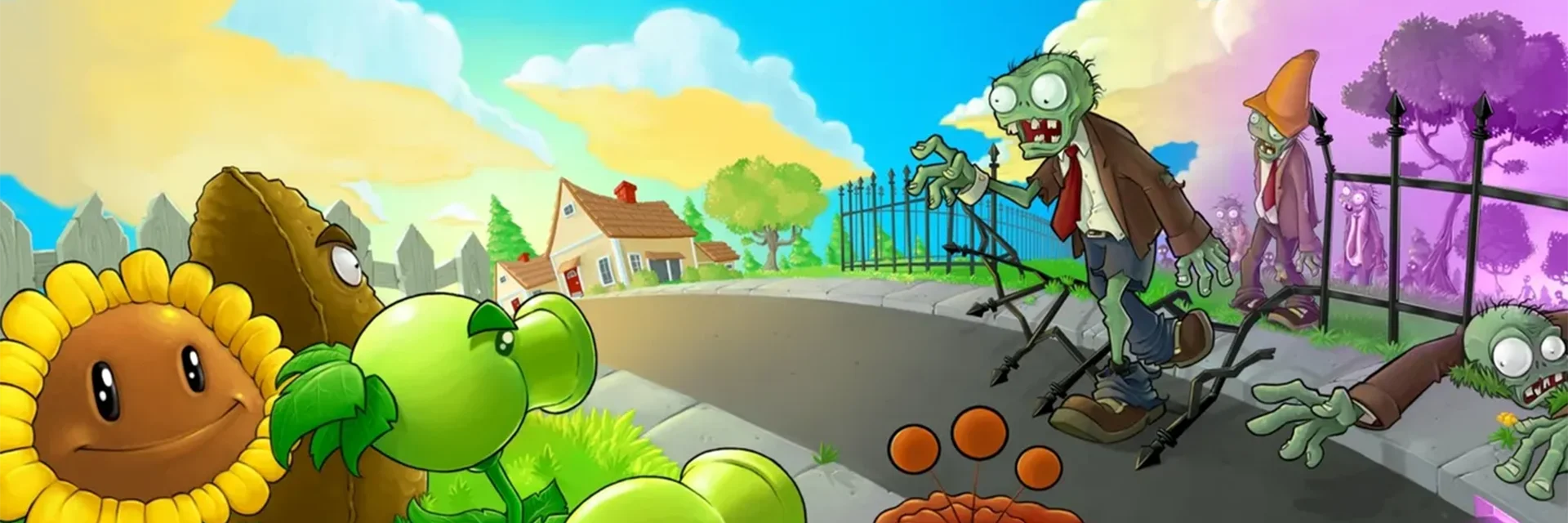
Dave gives the signal. Zomboss answers.
Both sides attack at once, burying the opponents beneath peas, spikes, explosives, footballs, zombie weapon fire and charging fighters. A huge explosion consumes the lawn before one final pea blasts everyone back onto the Smash stage.
The opening projectile can catch multiple opponents, who take repeated damage during the cinematic before receiving heavy knockback from the concluding blast.
Battle for the Lawn represents the central conflict of Plants vs. Zombies rather than focusing solely on Peashooter, allowing Crazy Dave, Dr. Zomboss and the franchise’s wider cast to take over without overcrowding his standard moveset.
A Small Plant Carrying a Very Big Publisher
The moveset works because Peashooter remains Peashooter.
Pea Cannon provides the horizontal pressure everybody expects, but it does not become his entire personality. Chili Bean Bomb creates a delayed obstacle that can occupy one route while Peashooter controls another, with the ability to knock the bomb around turning a familiar skill into something appropriately troublesome for Smash.
Pea Suped solves the mobility problem just as neatly. His natural movement can remain fairly modest because his explosive mobility exists as a temporary state. The boosted leap, improved steering and brief hover allow him to reposition without turning Peashooter into an unusually aerodynamic salad.
Pea Gatling is the kit’s sharpest translation. Rooting Peashooter creates serious sustained pressure, but the same decision removes his ability to walk, jump or even face the other direction. The meter keeps that pressure finite while preserving the central trade-off from the shooters. He becomes frightening because he has chosen one patch of ground and committed to it, not because the game has handed him a risk-free stream of projectiles.
Together, those specials create a clear rhythm. Pea Cannon establishes the lane. Chili Bean Bomb complicates the approach. Pea Suped lets Peashooter abandon a poor position or claim a better one. Pea Gatling turns that new position into a temporary stronghold.
That is not Piranha Plant with ammunition. It is tower-defence logic translated into a fighting game.
Even the ordinary attacks resist the temptation to pretend Peashooter attended martial-arts classes between Garden Warfare matches. Leaves, headbutts and close-range pea bursts fill the gaps without distracting from the core idea. His body bends, coils and springs in ways that suit the character, while his strongest physical attacks generally exist to restore the distance his specials need.
Battle for the Lawn then gives the Final Smash permission to do what the standard moveset wisely avoids. Crazy Dave, Dr. Zomboss and the wider conflict take over, with both armies turning one cinematic attack into a celebration of the franchise. Peashooter remains mechanically focused during normal play, then briefly allows the entire garden war to collapse onto one unfortunate opponent.
That balance sells the Deviation.
Peashooter remains an eccentric choice to carry Electronic Arts into Smash. EA Sports FC, Madden NFL and The Sims all represent larger pieces of the company’s history, and nobody is going to mistake one lawn-defending plant for a comprehensive summary of the publisher.
But Smash fighters are not annual reports.
They work when a character brings something recognisable, playable and difficult to reproduce elsewhere. Peashooter brings the language of tower defence, an unexpectedly long relationship with Nintendo hardware and a shooter-era toolkit that has already answered most of the questions Smash would ask of him.
He would not be the grandest possible EA representative. He would not be the most historically comprehensive one either.
He might, however, be the one most naturally suited to standing on a floating platform beside Mario, Kirby and an exercise instructor while everybody pretends this arrangement still requires explanation.
EA could make a louder entrance into Super Smash Bros. It would struggle to make a more Smash-like one.
And there is something wonderfully appropriate about one of gaming’s biggest publishers finally reaching the roster because a tiny green plant rooted itself beside the door, loaded the Pea Gatling and refused to move.
Leave a Reply